LAND CLEARING
Chipping, Burning or Hauling? The Smartest Way to Deal With Cleared Vegetation on Large Sites
25 September 2026 • 6 min read
Clearing land is only half the job. Every farm, estate and development site that gets cleared produces a mountain of branches, brush and timber, and what you do with that material decides how much the job really costs, how long it takes and how much risk you carry.
There are three common options: burn it, haul it away whole, or chip it on site. Here is how they compare on large commercial and agricultural jobs in Pretoria and across Gauteng.
The real problem is volume
Cut vegetation is mostly air. A pile of loose branches takes up far more space than the wood inside it, which means more truck loads, more handling and more time before the site is usable.
That is why the smartest disposal decisions start with one question: how do you reduce the volume where the material is lying, instead of moving it around in its bulkiest form?
Option 1: Burning
Burning looks free because nothing leaves the site. On commercial and agricultural land, it rarely is.
- Gauteng's dry season brings high veldfire risk, and burning may be restricted on high fire-danger days.
- You may need permission from your local municipality or fire protection association before burning.
- Large green piles burn slowly and can smoulder for days, tying up staff who have to watch them.
- Smoke causes complaints near estates, roads and neighbouring properties.
- It leaves ash and scorched ground on a site that is supposed to be getting ready for its next use.
On development and construction sites, open burning is often simply not an option. On farms, it adds risk at exactly the time of year when fire risk is highest.
Option 2: Hauling it away whole
Loading cleared vegetation onto trucks and removing it gets the material off site, but you pay to move mostly air.
- Loose branches fill a truck long before it reaches its weight limit, so the number of trips climbs quickly.
- Loading by hand or machine takes labour and time on every trip.
- Disposal sites may charge tipping fees or limit commercial loads.
- Heavy trucks moving in and out can damage access roads and wet ground.
Hauling whole material makes sense for small volumes close to a drop-off point. On large clearing projects, the costs multiply with every load.
Option 3: Chipping on site
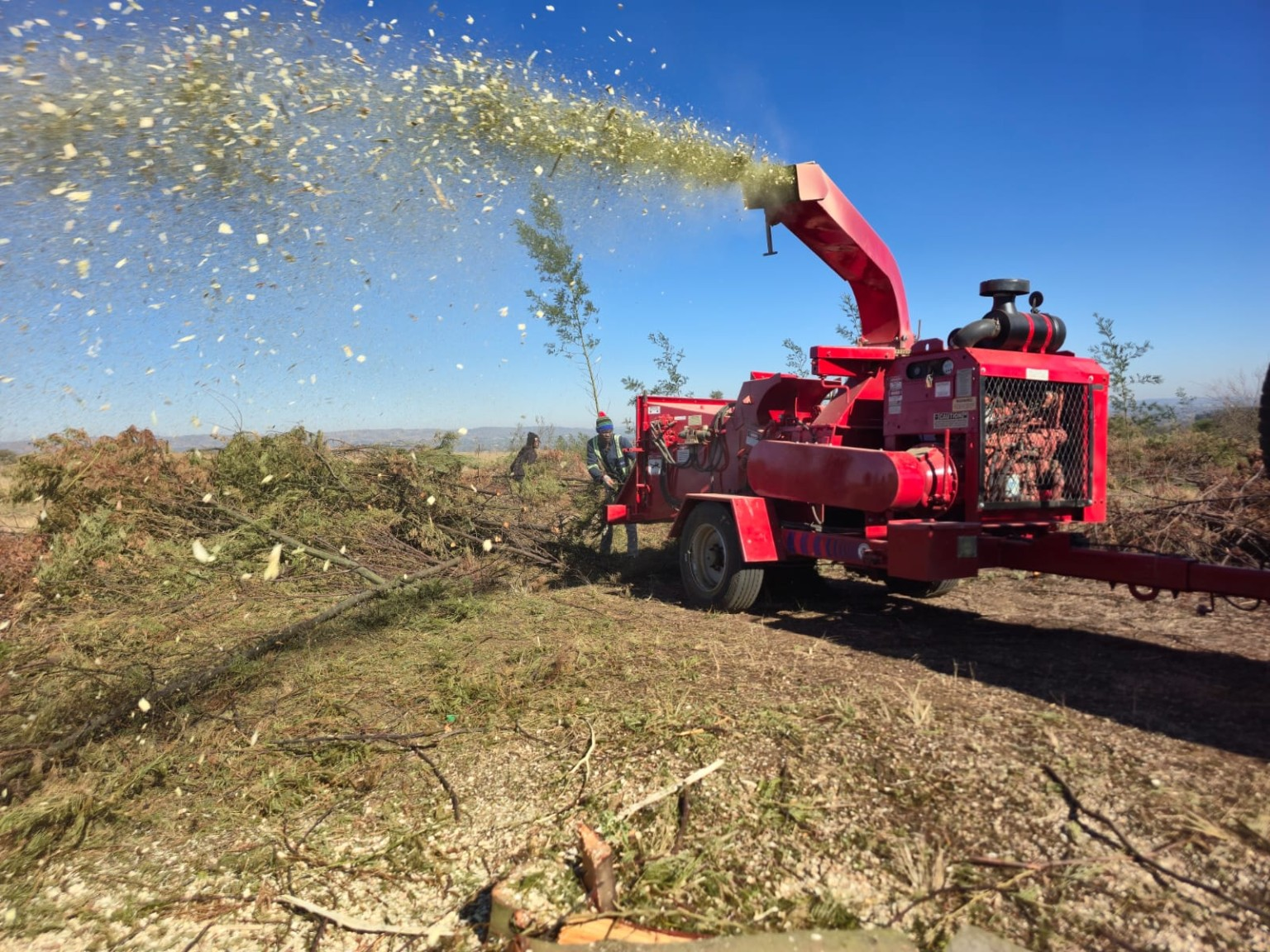
Commercial wood chipping reduces branches and timber into compact chips right where the clearing happens. This is where the numbers usually change in your favour.
- Volume drops dramatically, so there is far less to move, or nothing to move at all.
- Chips can often stay on site as mulch, ground cover on bare soil or material for access paths.
- If chips need to leave the site, they load far more compactly than loose branches.
- There are no open flames, no smoke and no smouldering piles to watch.
- Clearing and chipping happen in one sequence, so the site progresses daily instead of waiting for disposal.
The practical considerations are access for the machine and a plan for the chips. Very large stumps may also need separate handling, which is worth discussing during the site assessment.
Where on-site chipping makes the biggest difference
- Farms: debushing and firebreak work, where leaving cut material lying around adds to the fuel load you are trying to reduce.
- Developers and construction projects: site preparation on a schedule, where cleared material has to be gone before the next contractor arrives.
- Estates and commercial properties: large clearing jobs close to residents, where smoke and truck traffic are not acceptable.
- Large landowners: overgrown areas that have built up over years and need to be brought back under control.
How to plan disposal before clearing starts
- Estimate the volume. Walk the site and note the size and density of what needs to come out.
- Decide what happens to the chips. Will they stay on site as mulch or ground cover, or do they need to be removed?
- Confirm access. Check that a commercial chipper and support vehicles can reach the work area.
- Sequence the work. Plan clearing and chipping together so material is processed as it comes down, not left in piles.
A proper site assessment covers all four, so you know the approach and the cost before work begins.
The bottom line
For large-scale land clearing, the cheapest option on paper is not always the cheapest option on site. Burning carries risk and restrictions. Hauling whole material means paying to move air. On-site commercial wood chipping reduces the volume where it lies and keeps the project moving.
Chipperman provides commercial wood chipping, land clearing, debushing, firebreak clearing and site preparation for farms, estates, developers and commercial properties across Pretoria, Centurion, Midrand, Johannesburg and greater Gauteng.
Frequently Asked Questions
SITE CLEARED?
Get a free, no-obligation site assessment and quotation.
More guides
- Blue Gum and Black Wattle: Should You Burn or Chip Them?
- Wood Chips: From Clearing Waste to Valuable Resource
- Wood Chips as Boiler Fuel: A Guide for Factories and Industrial Users
- How Wood Chips Help Farmers: Soil, Water and Erosion Control
- Green Waste on Construction Sites: How Contractors Can Cut Volume and Cost